DigiSpace
Taking on new projects | SaaS development · Poznań

Your SaaS MVP, from idea to launch in 6–8 weeks

We design and build SaaS products on a solid base: separate data for each client company, Stripe subscriptions, background jobs and AI features where they make sense. The code is written by the developer you talk to, with no middlemen in between. We are based in Poznań and work with clients in Wielkopolska, across Poland and remotely.

Timeline
6–8 weeks to launch
Ownership
Code and servers are yours
Progress
Test server in the first week
Our projects

Products we built and run ourselves

Each of these systems is live. Open them and see how they work.

Our own SaaS product

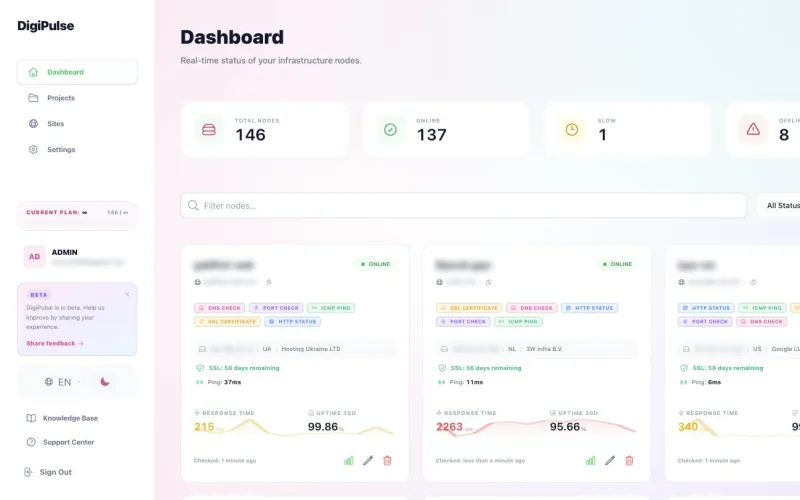
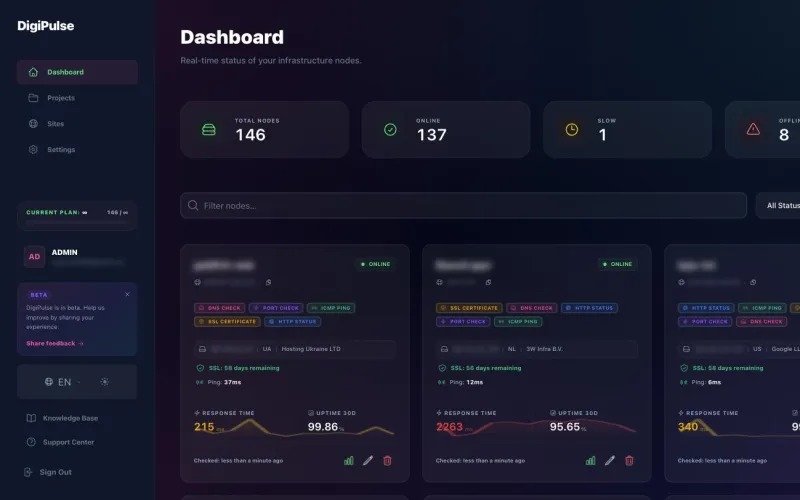
DigiPulse

Website uptime monitoring with incident alerts

Laravel Octane and Filament handle scheduling, Redis passes checks to workers written in Go, and alerts go out through Telegram and email. It also has an MCP server, so AI assistants can read monitoring data.

Laravel Octane Go Redis Filament PostgreSQL MCP
digipulse-engine.go

// Simplified: Go worker processing a check

func ProcessChecks(ctx context.Context) {

redis := rdb.Subscribe("checks:high-priority")

latency := worker.BenchmarkHTTP(target)

if latency > threshold {

alert.DispatchTelegram(tenantId)

}

}

Multi-tenant B2B platform

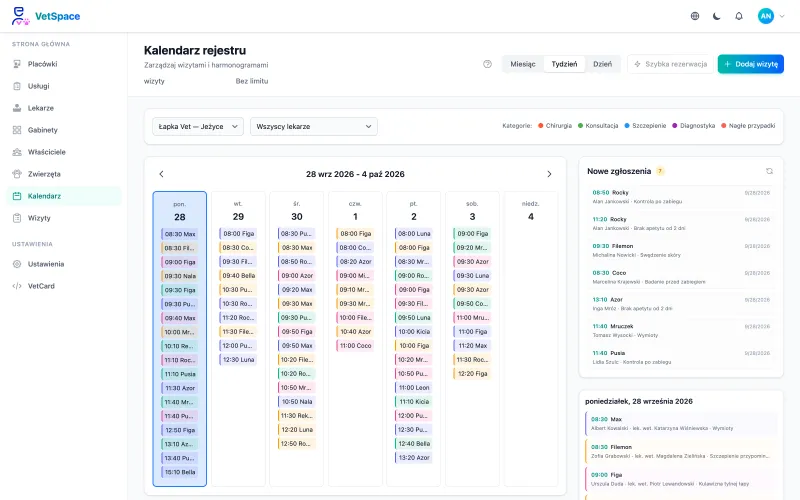
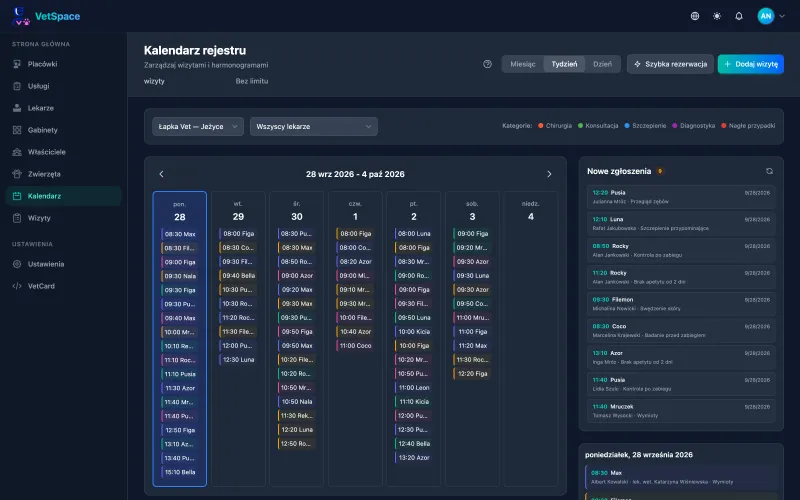
VetSpace & VetCard

Platform for veterinary clinics and pet owners

Every clinic has its own isolated data, its own subdomain or domain, online booking, a staff area and a Stripe subscription (Laravel Cashier). The Nuxt frontend renders pages on the server, so clinic pages load fast and are easy for search engines to index.

Laravel API Nuxt SSR Multi-tenancy Stripe Cashier Tailwind CSS PostgreSQL
V
clinic-central.vetspace.pro
Clinic workspace
Stripe
  • Clinic data is isolated from other clinics
  • Own subdomain or custom domain
  • Subscription billed through Stripe
AI & RAG platform

NetPostPanel

Content preparation with AI: source research, drafts, semantic search

A RAG pipeline: source research, web scraping, LLM-assisted drafting and vector embeddings. Qdrant handles semantic search, Langfuse tracks LLM cost and latency, and Laravel Horizon runs the queues, including scheduled automatic runs.

Laravel RAG Qdrant Langfuse Horizon LLM API
RAG Vector Pipeline Qdrant + Langfuse
1. Web Scraping 200 OK
2. Vector Embeddings 1536 dims
3. Semantic Search (Qdrant) top_k=5 cosine
4. LLM Synthesis & Tracing Langfuse Tracked
What’s included

Building blocks of a typical SaaS MVP

Which of these your product needs is agreed at the start. We don’t build what you won’t use.

Data isolation

Multi-tenancy

Each client company sees only its own data: a separate database or a shared one scoped by tenant. Custom domains and branding when needed.

Payments

Stripe subscriptions

Stripe Checkout, a customer portal for cards and plans, webhook handling, monthly and annual plans, invoices.

Performance

Background jobs

Slow work (PDFs, emails, scraping, AI requests) runs in queues so the interface stays responsive. Go workers are used where throughput actually matters.

Operations

Admin panel (Filament)

Manage users, companies and subscriptions, sign in as a user to reproduce issues, activity log and basic revenue figures.

AI

AI features and RAG

Semantic search over your documents (Qdrant), assistants that answer from your own data with sources, and structuring of user input with LLMs.

Infrastructure

Docker and deployment

Docker Compose, CI/CD on GitHub Actions and deployment to your own Hetzner, AWS or DigitalOcean account. No dependency on us for hosting.

How we work

What you can count on

Four rules we follow on every project.

First week

A test server from the first week

During the first week you get a password-protected test server. It updates as work progresses, so you see the product itself rather than status reports.

Tests

Automated tests

Unit tests cover business logic and billing; Playwright tests go through sign-up, onboarding and payment the way a user would. They run on every push, so regressions get caught before release.

Ownership

Code and infrastructure belong to you

Commits go to your private GitHub or GitLab repository from day one, and the application runs on your cloud account. No proprietary licences.

Direct contact

You talk to the developer

No project managers in between: you discuss tasks directly with the senior full-stack developer who writes the code (8+ years of commercial experience).

Comparison

How this differs from a typical agency

Agencies suit large teams and long projects. For an MVP, a smaller format is often enough.

Who writes the code
A team; you communicate through a project manager
✓ One senior developer you talk to directly
Time to MVP
Often 3–6 months
✓ 6–8 weeks for an agreed scope
MVP budget
Often $15,000+
✓ From $4,800 for a fixed scope
First working version
Often after the design phase
✓ On a test server in the first week
Testing
Depends on the team and budget
✓ Unit and Playwright tests are part of the scope
Code and servers
Depends on the contract
✓ Your repository and your cloud account from day one
Plan

Four two-week sprints to launch

Each sprint has a concrete result and ends with a demo on the test server.

01 Weeks 1–2

Architecture and foundation

A base that won’t need rewriting once the product grows.

Database design (PostgreSQL or MySQL)
Sign-in, roles and data separation between companies
Test server with automatic deployment (CI/CD)
Basic interface layout and UI components
02 Weeks 3–4

Core features and payments

The main thing your product does, plus subscriptions.

Core product logic
Stripe Checkout and customer portal (plans and subscriptions)
Stripe webhook handling (renewals, cancellations, invoices)
Queues for background jobs
03 Weeks 5–6

User area and admin panel

What your customers and your team will work in.

Responsive user dashboard (Tailwind CSS, Vue or Blade)
Filament admin panel for companies and subscriptions
AI features or third-party API integrations, if in scope
Email templates and notifications
04 Weeks 7–8

Testing and launch

End-to-end tests, security checks and production release.

Playwright tests for sign-up, onboarding and payment
Query optimisation, caching and a security review
Deployment to your cloud (Hetzner, AWS or DigitalOcean)
Documentation, repository handover and an admin panel walkthrough
Pricing

Two ways to work together

A fixed-scope sprint to launch an MVP, or a monthly arrangement for a product that is already live.

For a new product 6–8 weeks

SaaS MVP

For founders who want to launch, test demand and get their first paying customers.

from $4,800
≈ 19,000 PLN · fixed scope
Database design and data separation between companies
Stripe subscriptions: checkout, customer portal, invoices
User dashboard and Filament admin panel
Test server from the first week
Unit and Playwright tests
Docker deployment to your cloud account
Full handover of code and documentation
2 weeks of post-launch bug fixes included
For a live product Monthly

Fractional CTO

For a live SaaS that needs senior technical help: new features, refactoring, AI integrations, scaling.

from $2,400
≈ 9,500 PLN · per month
Architecture, SQL and security review
Complex backend work (AI, RAG, Go workers)
Load testing and preparation for growth
Code review and CI/CD improvements
Direct Telegram channel
A reserved number of hours per week

Client feedback

“He was able to design the database, set up the code architecture, and plan for future releases. He works independently, reviews and debugs code, and consistently suggests improvements while spotting logical flaws in the system. … He has always been available to support the project when needed, never makes excuses, and communicates clearly.”
Client review on Upwork
“Yurii is a responsible specialist who can work autonomously on a wide range of tasks. He has solid expertise in PHP (Symfony, Laravel) and JavaScript frameworks (Vue.js, Angular) — able to independently investigate complex issues, identify root causes, and implement effective solutions.”
Recommendation on LinkedIn
FAQ

Common questions

Timelines, payments, hosting and working together.

Why 6–8 weeks?

The first version covers the 3–5 features that solve your users’ main problem and that they will pay for. Sign-in, multi-tenancy and Stripe billing are built from ready, tested modules rather than from scratch. If the scope is larger, we say so at the estimate stage.

Who owns the code?

You do. All work is committed to your private GitHub or GitLab repository from the first day. Code, accounts and access stay with you.

Where will the application run, and how much does hosting cost?

In Docker on your own cloud account (Hetzner, AWS or DigitalOcean). For an MVP, a VPS for about $15–35 a month is usually enough; we will size it for your expected load.

What do you need from me to start?

A short description: what problem the product solves, for whom, and how it will make money. On a 30-minute call we agree on the MVP scope and put together a technical brief.

How do you reduce the risk of production bugs?

Unit tests cover business logic and billing, and Playwright tests go through sign-up, onboarding and Stripe payment before every release. That does not rule out bugs, but it catches regressions before users do.

How does payment work?

Payment is split by sprint: usually 25% at the start of each two-week sprint; escrow is also possible. You see the result of each sprint on the test server before paying for the next one.

Do you work with companies in Poznań and Wielkopolska?

Yes. We are based in Poznań, so for clients from Poznań and the surrounding area we can meet in person, for example for the kick-off or the launch. Clients from the rest of Poland and abroad work with us remotely, with the same process.

Get in touch

Tell us about your product

Message us on Telegram, or fill in the short form and we will reply with a scope and timeline estimate.