
Custom Software Development Services: Tailored to Your Business Needs
In today's highly competitive digital landscape, custom software development is not a luxury—it's a necessity. Developing software that aligns perfectly with your business goals can be a game-changer. This is where our custom software development services come into play, providing a bespoke solution designed to meet the unique demands of your enterprise.
Why Custom Software?
- Personalization: Unlike off-the-shelf products, custom software is crafted to accommodate the distinct needs and processes of your business, providing a snug fit solution.
- Cost-Effectiveness: While the initial investment may be higher, custom software avoids future expenses by eliminating the need for extensive modifications.
- Speed of Implementation: Tailored software requires a careful development process, ensuring that every feature aligns with business needs, hence might take longer to deploy than off-the-shelf solutions.
- Functionality: Custom development ensures that every feature serves a purpose, enhancing your business efficiency and productivity.
The Development Process
- Requirement Analysis: The critical first step where we dive deep into your needs to outline a clear development plan.
- System Architecture Design: We establish the software structure, component interactions, and select the appropriate technical solutions.
- Coding and Development: Our developers craft the code, test functionalities, and optimize the product for peak performance.
- Testing and Debugging: After development, the software undergoes thorough testing to ensure reliability before and after deployment.
- Deployment and Support: The final stage includes installation, staff training, and ongoing user support, with additional adjustments and updates as needed.
Choosing Us Means
Expertise: With years of experience in custom software development, our team brings a wealth of knowledge across various technologies.
Efficiency and Quality: We leverage cutting-edge tools and methodologies to create software that works for you.
Support and Maintenance: Post-deployment, we provide regular updates, bug fixes, and prompt support.
Competitive Pricing: Our services are priced to offer the best value for your investment, with a focus on long-term benefits.
Your Next Steps: Don't put your ideas on hold. Contact us today to begin crafting software that propels your business forward. With our commitment to excellence and a client-focused approach, we're ready to help you achieve success and maintain control in your business endeavors.
Keywords: Custom Software Development, Business Solutions, Efficiency, Personalized Software, Business Growth.
Laravel for E-commerce: From Packages to Headless Architecture
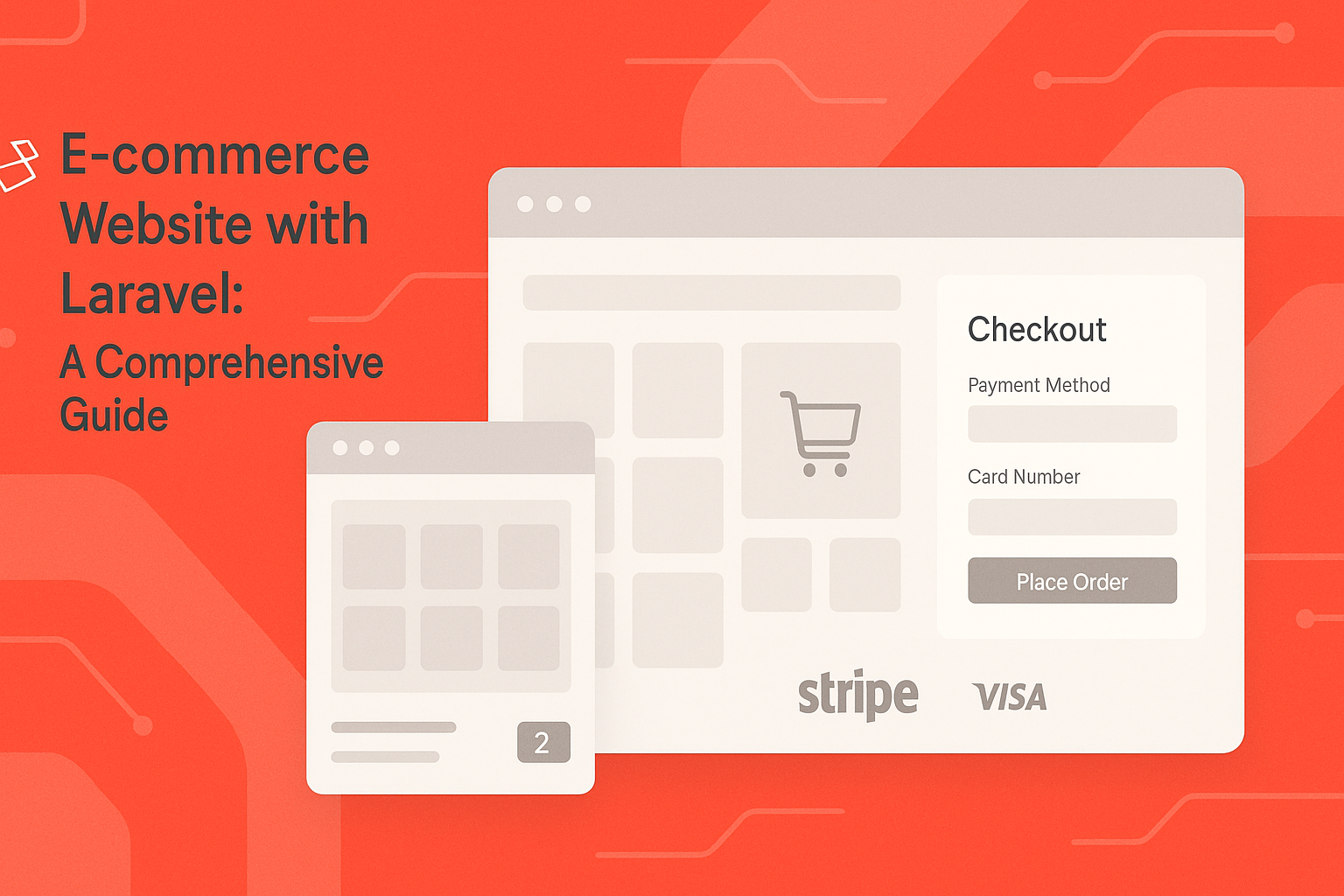
For most companies, a website is no longer just an online office or a digital showcase—it is part of the core business process, especially for online stores, marketplaces, and service-based platforms. Ready-made solutions like Shopify, WooCommerce, or Magento are excellent for quick launches, but they often reach their limits once a business needs custom order processing, multi-warehouse inventory management, or unique pricing rules tailored to specific requirements.
This is where Laravel shines. As a robust PHP framework, it combines structure with freedom: you can keep the codebase clean, extend functionality with community packages, or build fully custom features from scratch. In this article, we explore how Laravel supports flexible e-commerce solutions, with practical notes on architecture, recommended packages, and deployment practices.
Why Choose Laravel for E-commerce?
Laravel provides the flexibility to build custom features while leveraging an ecosystem of thousands of community packages. This balance makes it a strong foundation for e-commerce platforms, offering more freedom and scalability than most popular CMS solutions.
- Open-Source Advantage—Full control over the codebase enables deep customization and continuous innovation.
- Scalability—Adapts to growing business needs, from higher traffic to larger product catalogs and complex workflows.
- Security—Built-in protection against CSRF, SQL injection, and XSS helps safeguard sensitive customer data.
- MVC Architecture—A clean, organized structure that speeds up development, simplifies maintenance, and improves collaboration.
- Extensive Ecosystem—Thousands of community packages accelerate delivery, lower costs, and prevent reinventing the wheel.
- Flexible Storefronts (Headless Approach)—Decouples the frontend from the backend so one system can power multiple storefronts—from websites to mobile apps—with greater flexibility, security, and performance.
- API-First Approach—Makes it straightforward to build APIs for seamless integration with storefronts, mobile apps, and third-party services.
Headless E-commerce with Laravel
A headless e-commerce architecture separates the customer-facing frontend from the backend business logic and data handling, providing significant benefits:
- Flexibility—Choose modern frontend technologies like Vue.js, React, or Angular to craft tailored user experiences.
- Performance—Faster page loads and improved responsiveness lead to higher customer satisfaction.
- Omnichannel Presence—Deliver consistent shopping experiences across web, mobile apps, and even IoT devices.
- Enhanced Security—Isolating backend logic from the presentation layer reduces the overall attack surface.
Laravel-based packages such as LunarPHP facilitate headless commerce with a robust RESTful JSON:API and an intuitive Livewire-powered admin panel.
Popular Laravel E-commerce Packages
Selecting the right Laravel package can significantly speed up development and ensure essential capabilities are covered. Here’s a quick overview:
- Bagisto—Open-source platform supporting marketplaces, multi-store setups, PWAs, and B2B commerce.
- Lunar—Ideal for headless solutions with clean architecture, JSON:API, and robust management capabilities.
- Aimeos—High-performance, API-first solution suitable for large-scale e-commerce, marketplaces, and B2B scenarios.
- Vanilo—A streamlined framework emphasizing Laravel’s simplicity for quick, efficient projects.
- AvoRed—Modular, customizable shopping cart for tailored functionality.
- Laravel Shopping Cart—Straightforward package for basic cart implementations.
- Cashier—Integrates subscription billing with Stripe or Paddle.
- Laravel PayPal—Provides seamless PayPal payment integration.
Laravel vs. Ready-made CMS: Comparison
| Feature | Laravel E-commerce Packages | Ready-made CMS (Shopify, WooCommerce, Magento) |
|---|---|---|
| Customization | High; complete code control | Limited by themes/plugins |
| Scalability | Highly scalable | Varies based on CMS |
| Security | Requires careful implementation | Managed by CMS; frequent updates |
| Development Time | Longer; coding expertise required | Shorter; quick setup and out-of-the-box functionality |
| Cost | Potentially lower in the long term | Subscription/transaction fees accumulate |
| Technical Skill | Requires skilled Laravel developers | Manageable with less technical knowledge |
Final Thoughts
Laravel offers a flexible, future-proof foundation for e-commerce. By combining clean architecture, a rich package ecosystem, and support for modern patterns like headless commerce, it enables secure, scalable, and fully tailored solutions. Whether you are starting with a simple store or building a complex multi-channel platform, Laravel provides the tools and ecosystem to bring that vision to life—without being boxed in by the limits of ready-made platforms.
“Ready-made platforms limit growth. Laravel opens the door to tailor-made e-commerce that scales with your business.”
🚀 Build Your Next E-commerce with Laravel
Thinking about building or scaling your e-commerce platform? At DigiSpace, we help businesses design tailored Laravel solutions—from architecture and package selection to deployment and optimization.
Contact Us TodayWebsite Down!? Monitoring Uptime, SSL, and Status History
You're working, focused on a task. A client messages: "The site isn't working."
You check — it's down. No idea when it happened. The logs might have nothing. The client doesn't know either.
Maybe an hour ago. Maybe overnight. During that time, people visited, saw an error, and left. Without a word.
And if there's no monitoring system — it'll keep happening.
Why This Happens
Agencies typically manage a number of client sites — anywhere from a few to dozens. Each one runs on its own.
Checking each one manually isn't realistic. So you find out about an outage either from the client or by accident.
Same for business owners managing multiple sites with no alert system: you simply don't know if they're all up right now.
No system — no control.
What Is Uptime Monitoring
Simple: the system automatically checks a site at a set interval — say, every few minutes.
If it doesn't respond — you get an alert. Immediately, not an hour later.
It records whether the site responds, how fast, and what status code it returns. Every outage logged with a start time. When the site recovers — a separate notification.
SSL Certificates: The Silent Risk
An SSL certificate expires. The browser shows a red warning. The user sees "Not secure" and closes the tab.
Google notices too.
Renewing on time is easy — if you know when. But when you have dozens of certificates, it's easy to miss one. Monitoring shows how many days are left for each and sends a notification in advance.
Why I Built DigiPulse
I run several of my own projects and maintain third-party sites.
Existing tools are either overloaded with features I don't need, or they're missing what I actually want — the right information, a clean view, a reasonable limit on monitored objects.
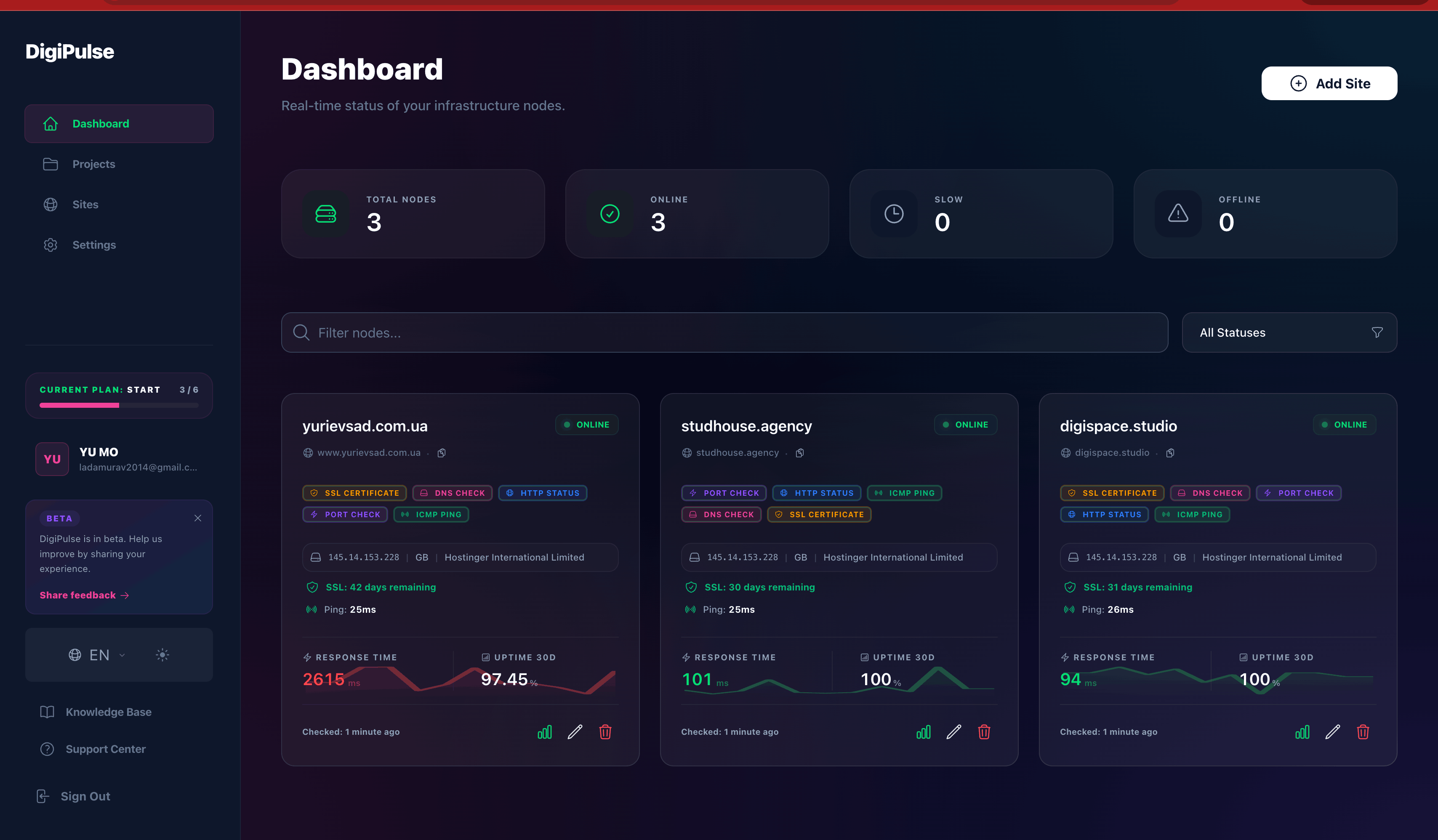
I needed a dashboard: open it, see the state of all sites. Nothing extra.
That's how DigiPulse was born.
What DigiPulse Tracks
Uptime — whether the site is up and for how long. Every outage with an exact start time.
SSL — how many days until the certificate expires. Alert arrives in advance.
Status history — when it went down, how long, how often. You can tell whether it's a recurring issue or a one-off.
Alerts via Telegram or email — sent after the problem is confirmed, no false positives.
MCP integration — connects to Claude, Cursor, and other AI tools. Query site status directly from there, without opening the dashboard.
Who It's For
Agencies managing client sites who want to know about problems first.
Business owners without a dedicated person for monitoring.
Try It
DigiPulse is in beta. If you manage client sites or have your own — give it a try and let me know what you think.
Categories
Latest Posts
Archive